Download the chapter : Here
(A) Use your brain power !
Some rava has got mixed with sago pearls or sabudana. What sieve should we use to separate the two – the one that allows rava to pass through or the one that allows sago ?
Ans. To separate rava and sabudana, we shall use the sieve that allows rava to pass through, the one that remains in the sieve will be sabudana. Thus the two can be separated.
(B) Answer the following questions.
1. Name the substances used to make the solution called lemon sherbet.
Ans. The substances used to make the solution called lemon sherbet are: lemon, sugar, salt and water.
2. Why is it that water that looks clean and transparent may not be fit for drinking ?
Ans. Water that looks clean and transparent may not be fit for drinking because harmful micro-organisms, that cannot be seen with naked eyes may be present in water. These micro-organisms if entered our body can cause us diseases and can be harmful for our health.
3. When making a sherbet, what do we do to make sugar dissolve quickly ?
Ans. When making a sherbet, we stir with a spoon so that the sugar dissolves quickly in the water.
4. Does oil float on water or sink in it ?
Ans. Oil floats on water as oil is lighter than water.
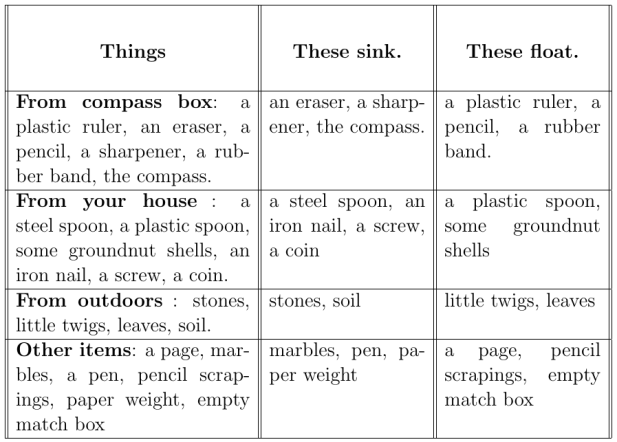
(C) Complete the table.
1. Write the information you obtained from the floating-sinking experiment, in the table below.
Repeat the experiment with other things besides those mentioned in the lesson. Write their names, too, in the proper places in the table.
(D) Fill in the blanks.
1. Substances like salt and sugar dissolves after some time when added to water.
2. The mixture obtained on dissolving a substance in water is called a solution .
3. ORS is an example of useful solutions.
4. All micro-organisms are not useful. Some can cause diseases if they enter our body.
5. Things that float in water are lighter than it and things that sink are heavier than it.
6. A substance called alum is swirled in muddy water to help clean the water.
(E) True or false ?
1. Alum powder does not dissolve in water. False
2. Micro-organisms cannot live in water. False
3. If muddy water remains still, a sediment is formed at its bottom. True
4. An eraser floats in water. False
5. Tea leaves can be separated from tea by filtration. True
(F) How can we tell that water has become transparent ?
Ans. We can tell that water has become transparent by doing a simple experiment. Take some water in a glass. Now try to see through the glass from one side to the other. If we can clearly see through the glass, we can say the water in the glass is transparent.
*********************
Discover more from Dr. Ganesh Visavale
Subscribe to get the latest posts sent to your email.
 Dr. Ganesh Visavale
thank you DR.GANESH VISAVALE
LikeLiked by 1 person
Most welcome. I’m glad, it was of help 😊
LikeLike
🤴🤴🤴🤴🤴
LikeLike
this was too useful
thank you for that
LikeLiked by 1 person
You are most welcome!
LikeLike
Thank you sir for all answer
LikeLiked by 1 person
it helpful for children thank you sir.
LikeLiked by 1 person
Most welcome 😊
LikeLike
Sir can u upload the Maharashtra English 4th std remaining all lesson
LikeLiked by 1 person
Surely, you will soon find it.
LikeLike
👍👌👌
LikeLiked by 1 person
Thanks ! 👍
LikeLike
Hii
LikeLike
Thank you Sir.
It is very useful notes.
as my daughter is in class 4.
It helped a lot.
LikeLiked by 1 person
Thanks for the appreciation ! I’m glad that it was helpful 😊👍
LikeLike
most thanku sir
LikeLiked by 1 person
You are most welcome Krutika 😊👍
LikeLike
Thanks you for helping or give me some answers thank you very much for you help me God bless you byy
LikeLiked by 1 person
Most welcome ! I’m glad that it was helpful to you 😊👍
LikeLike
Shreeraj
.
LikeLike
Thanks sir
LikeLiked by 1 person
Thanks sir
LikeLiked by 1 person
U r most welcome Rudra !
LikeLike
Shreeraj
LikeLike
Shreeraj
LikeLike
Shreeraj
LikeLike
Thank you so much sir it’s so helpful for me
LikeLiked by 1 person
Monika Arvind Mishra, you are most welcome !
LikeLike
thanks sir
LikeLiked by 1 person
You r most welcome ! 🙂
LikeLike