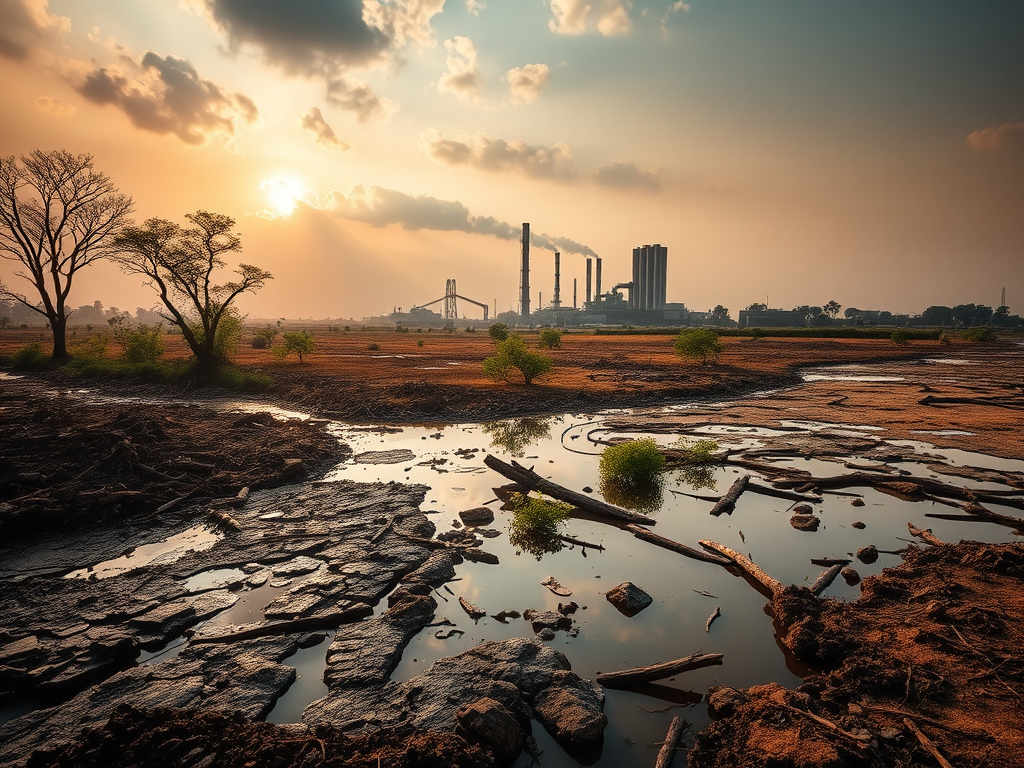
Environmental law in India has evolved significantly over the past few decades, largely due to progressive judicial interventions. Among the most important judgments in this field is Vellore Citizens’ Welfare Forum vs. Union of India, AIR 1999 SC 812. This case is a milestone because it established two crucial doctrines — the Precautionary Principle and the Polluter Pays Principle — as part of the law of the land. It emphasized sustainable development and the duty of industries to operate responsibly.
Background of the Case
The case was filed as a writ petition under Article 32 by the Vellore Citizens’ Welfare Forum, a public-spirited organization concerned about the severe pollution caused by tanneries and industries in Tamil Nadu. The tanneries were discharging untreated toxic effluents into agricultural lands, waterways, open fields, and the Palar River. This contaminated groundwater, destroyed crops, and posed serious health hazards to the local population.
The Tamil Nadu Pollution Control Board had already issued several warnings and directions to these industries, but most industries continued violating environmental norms. Seeing the growing environmental degradation, the petitioner approached the Supreme Court to seek relief and accountability.
Issues Before the Supreme Court
- Whether the Supreme Court could direct polluting industries to compensate affected villagers.
- Whether the Precautionary Principle and Polluter Pays Principle should be treated as part of Indian environmental law.
- Whether tanneries should be allowed to continue functioning without proper effluent treatment plants.
- Whether sustainable development requires stricter environmental norms for industries.
Judgment
The Supreme Court delivered a historic judgment reinforcing the idea that environment and development are not opposing goals. The Court observed that industrial development is necessary but must not happen at the cost of ecological balance.
1. Precautionary Principle as Part of Indian Law
The Court held that the Precautionary Principle is an essential feature of the concept of sustainable development. According to this principle, where there are threats of serious or irreversible damage, lack of scientific certainty should not be used as a reason to postpone measures to prevent environmental degradation.
This placed a proactive duty on industries and regulatory bodies to anticipate and prevent environmental harm, not simply react to it after damage occurs.
2. Polluter Pays Principle Recognized
The Court explicitly declared that the Polluter Pays Principle is not just a slogan but a legally binding obligation. Industries causing environmental harm are liable to compensate victims and restore the degraded environment.
This is significant because it shifts the financial burden from the victims (usually poor farmers and villagers) to the polluting industries.
3. Sustainable Development as a Balancing Tool
The Court reinforced that sustainable development should guide all environmental decisions. It balanced economic progress with ecological protection, stating that development should not compromise the ability of future generations to meet their needs.
4. Directions to Industries and the Government
The Court ordered:
- Tanneries and industries operating without effluent treatment plants to be closed down immediately.
- Industries causing pollution to pay compensation to affected persons.
- An Environment Protection Fund to be created for restoration work.
- The State Government to ensure installation of common effluent treatment plants (CETPs).
- Industries to bear the full cost of reversing environmental damage.
The Court thus not only declared principles but also gave practical and enforceable directions — a hallmark of environmental PILs in India.
Why This Case Is a Milestone
A. Constitutional Backing: Article 21
The Supreme Court relied on Article 21, interpreting the right to life to include the right to a clean and healthy environment. This built on earlier cases such as:
- Subhash Kumar v. State of Bihar (1991) – Right to pollution-free water.
- M.C. Mehta v. Union of India (Ganga Pollution Case, 1988) – Closure of polluting industries.
By placing environmental protection within Article 21, the Court created a powerful constitutional safeguard.
B. Influence of International Environmental Law
The Court referred to:
- Rio Declaration (1992)
- Brundtland Report (1987)
This helped integrate global sustainable development standards into Indian law.
C. Strengthening Public Interest Litigation (PIL)
The judgment reaffirmed that the environment is a matter of public concern, and citizens’ groups have the right to approach the Court through PILs to protect environmental rights.
D. Expanding the Responsibilities of State and Industries
The Court emphasized the duty of the State under Article 48A and the duty of citizens under Article 51A(g) to protect the environment.
Related Landmark Case Laws
Several other judgments built on or supported the principles in this case:
- Indian Council for Enviro-Legal Action v. Union of India (1996)
– Strongly applied the Polluter Pays Principle; held industries liable for toxic pollution. - M.C. Mehta v. Kamal Nath (1997)
– Introduced the Public Trust Doctrine for environmental protection. - Narmada Bachao Andolan v. Union of India (2000)
– Discussed sustainable development as a balancing mechanism. - A.P. Pollution Control Board v. Prof. M.V. Nayudu (1999)
– Emphasized scientific uncertainty and need for expert bodies.
Conclusion
The Vellore Citizens’ Welfare Forum judgment remains one of the pillars of Indian environmental jurisprudence. By giving legal force to the Precautionary and Polluter Pays Principles, the Supreme Court ensured that environmental protection is not just a governmental duty but a constitutional requirement. It strengthened public accountability, empowered citizens, and laid a strong foundation for sustainable development in India.
References
- Vellore Citizens’ Welfare Forum v Union of India AIR 1999 SC 812.
- Indian Council for Enviro-Legal Action v Union of India (1996) 3 SCC 212.
- MC Mehta v Union of India (1988) 1 SCC 471.
- MC Mehta v Kamal Nath (1997) 1 SCC 388.
- Narmada Bachao Andolan v Union of India (2000) 10 SCC 664.
- A P Pollution Control Board v Prof M V Nayudu (1999) 2 SCC 718.
- Subhash Kumar v State of Bihar (1991) 1 SCC 598.
- World Commission on Environment and Development, Our Common Future (Oxford University Press 1987).
#VelloreCase #EnvironmentalLawIndia #PolluterPays #PrecautionaryPrinciple #SustainableDevelopment #EnvironmentalJudgments #SupremeCourtOfIndia #LandmarkCases #EnvironmentalProtection
Discover more from Dr. Ganesh Visavale
Subscribe to get the latest posts sent to your email.
 Dr. Ganesh Visavale
1 Comment