
Law has long been known for its complexity — full of archaic terms, Latin phrases, and intricate sentence structures that often confuse the very people it seeks to protect. However, the 21st century is witnessing a quiet revolution in legal communication. A growing global movement towards plain language and the rise of artificial intelligence (AI)-assisted drafting tools are reshaping the way legal professionals write, interpret, and communicate.
The future of legal language lies at the intersection of clarity and technology — where philosophy meets innovation. This transformation is not merely linguistic but also deeply philosophical, aiming to make the law more democratic, inclusive, and understandable. Example: In 2023, the U.K. Ministry of Justice launched a pilot program to rewrite family law forms in plain language — resulting in a 30% drop in user confusion and filing errors.
This blog explores the historical roots of legalese, the rise of plain-language reform, the role of AI in legal drafting, and the philosophical implications of human-AI collaboration — concluding with emerging challenges and future directions.
The Problem: Legalese and Its Philosophical Roots
“Legalese” refers to the traditional form of legal writing marked by verbosity, repetition, and archaic vocabulary. Historically, it served two purposes — precision and authority. Lawyers used complex words like heretofore, therewith, or notwithstanding to maintain exactness and convey formality.
Philosophically, legal language developed as a closed system meant for specialists. The positivist view of law, represented by thinkers like H.L.A. Hart, saw law as a set of rules defined by institutions rather than morality or common understanding. Consequently, legal language became technical — a language of power rather than participation.
However, postmodern jurisprudence and movements in legal linguistics argue that law, as a public instrument, must be understood by the people it governs. The language of law should not alienate but empower. This shift gave birth to what we now call the plain-language movement.
The Plain-Language Movement: Making Law Understandable
The plain-language movement began in the 1970s in countries like the United States, Canada, and the United Kingdom, advocating that legal and official documents should be written in language that the average citizen can understand.
Philosophical foundation:
This movement is grounded in the democratic ideal that access to justice begins with access to understanding. As Jeremy Bentham once said, “The law should be written so that it can be understood by those who are bound by it.”
Practical progress:
- The U.S. enacted the Plain Writing Act of 2010, requiring federal agencies to write documents clearly.
- The U.K.’s Legal Services Act 2007 encouraged transparency in legal communication.
- In India, the Supreme Court and Law Commission have also recommended simplification of legal documents and judgments for public understanding.
Example:
Instead of writing —
“The party of the first part shall indemnify and hold harmless the party of the second part…”
Plain language advocates suggest —
“You must compensate the other party if your actions cause any loss.”
This change is not just stylistic. It represents a philosophical transition — from law as command to law as communication.
Table: Legalese vs. Plain Language Examples
| Legalese Phrase | Plain Language Equivalent |
|---|---|
| “Notwithstanding anything hereinbefore contained…” | “Despite what was said earlier…” |
| “The party of the first part shall indemnify…” | “You must pay for any loss you cause…” |
| “Hereinafter referred to as…” | “From now on called…” |
AI-Assisted Drafting: Technology Meets Language
While plain language democratizes legal access, AI-assisted drafting accelerates and scales that transformation — making clarity not just possible, but practical. While plain language simplifies legal communication, AI-assisted drafting takes it a step further by making legal writing faster, more accurate, and adaptive. AI tools like Lexis+, ChatGPT, Casetext CoCounsel, Harvey AI, and Lawgeex are transforming how contracts, petitions, and judgments are written.
How it works:
AI models trained on legal corpora analyze thousands of documents to identify best practices, standard clauses, and potential risks. They can generate drafts, check for inconsistencies, or even suggest plain-language alternatives to complex sentences. Example: Lawgeex flagged the clause “terminate without prejudice” and suggested “end the agreement without affecting future rights” — improving clarity for non-lawyers.
Philosophical implication:
The integration of AI into legal drafting raises profound questions about authorship, accountability, and interpretation. If AI drafts a contract, who is responsible for the meaning of its clauses? Can machines truly “understand” the normative essence of law — justice, fairness, or equity?
Here lies a fascinating philosophical tension:
- Plain-language movements humanize the law.
- AI-assisted drafting mechanizes it.
The challenge is to balance clarity with conscience.
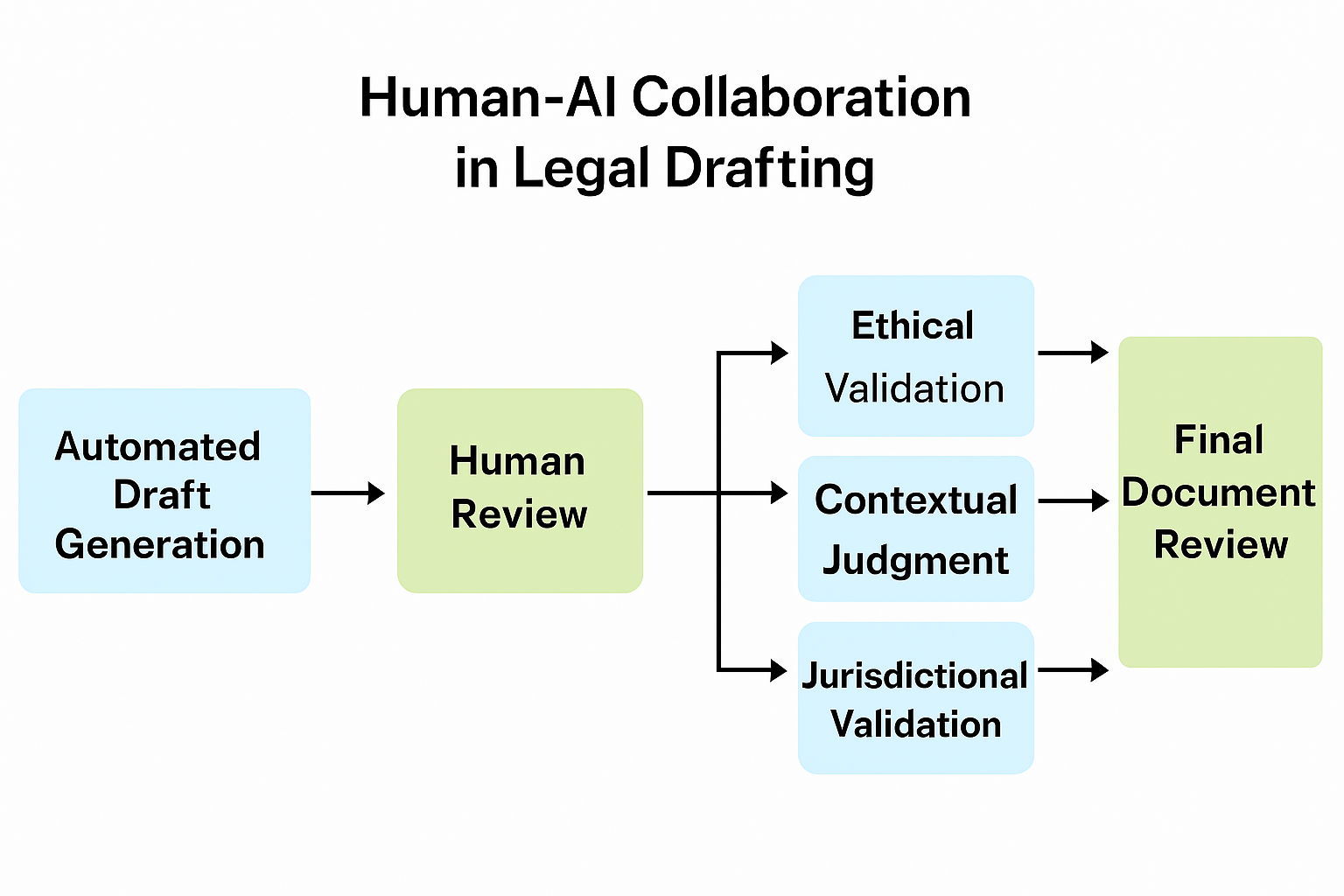
The Human-AI Collaboration in Legal Language
The future likely belongs not to AI or humans alone but to collaborative intelligence. AI can assist in repetitive, technical tasks — such as ensuring consistency, citation accuracy, or compliance — while human lawyers provide context, ethical judgment, and interpretative depth.
This human-AI collaboration will redefine legal authorship. Lawyers will evolve from “drafters” to “editors” of meaning — reviewing, refining, and ensuring that legal documents communicate the right intent.
Example:
An AI might draft a lease agreement using standard templates, but a human lawyer ensures it aligns with local housing laws, ethical principles, and the client’s unique situation.
Philosophical insight:
This reflects hermeneutics — the philosophy of interpretation. Machines process syntax; humans understand semantics and ethics. Together, they may bring the law closer to what it was always meant to be — a rational, just, and accessible system.
Emerging Challenges
Despite its promise, the future of legal language faces serious challenges:
- Bias in AI models – If AI learns from biased legal data, it may reproduce unfair or discriminatory patterns.
- Loss of nuance – Excessive simplification might erase necessary legal precision. Note: In criminal law, simplifying “mens rea” to “intent” may obscure distinctions like recklessness or negligence — risking misinterpretation.
- Ethical responsibility – Determining accountability when AI-generated drafts cause harm remains unresolved.
- Digital divide – Many developing nations, including India, still lack the infrastructure and training to adopt AI drafting widely. Governments and bar councils could offer subsidized AI drafting tools and training for small firms and legal aid centers — ensuring equitable access to legal tech.
The goal, therefore, should not be to replace lawyers with AI but to create augmented lawyers — professionals who combine linguistic clarity, technological competence, and ethical reasoning. These transformations invite us to rethink not just how law is written, but how it is lived — as a shared language of justice.
Conclusion
The evolution of legal language from archaic legalese to plain, AI-supported expression represents more than just linguistic reform — it is a philosophical transformation. It reflects a shift from exclusivity to inclusivity, from rigidity to adaptability, and from authority to accessibility.
In the near future, legal communication will not only be written for lawyers but for the people. AI will assist, not dominate; plain language will clarify, not dilute; and together they will redefine how justice speaks — clearly, compassionately, and comprehensibly.
References
- Bentham, Jeremy. The Works of Jeremy Bentham, Vol. 5, 1843.
- H.L.A. Hart, The Concept of Law, Oxford University Press, 1961.
- Plain Writing Act of 2010, U.S. Federal Law.
- Charrow, V., Erhardt, M., & Charrow, R. (1979). “Clear and Effective Legal Writing.” Harvard Law Review.
- Ashley, Kevin D. (2017). Artificial Intelligence and Legal Analytics: New Tools for Law Practice in the Digital Age. Cambridge University Press.
- Law Commission of India, Report No. 267 (2017): Simplification of Legal Language.
#PlainLanguageLaw #LegalAI #AIinLaw #LegalDrafting #LawAndPhilosophy #FutureOfLaw #LegalLanguage #LegalTech #AccessToJustice #LawReform #LegalCommunication #LegalInnovation #DrGaneshVisavale
Discover more from Dr. Ganesh Visavale
Subscribe to get the latest posts sent to your email.
 Dr. Ganesh Visavale