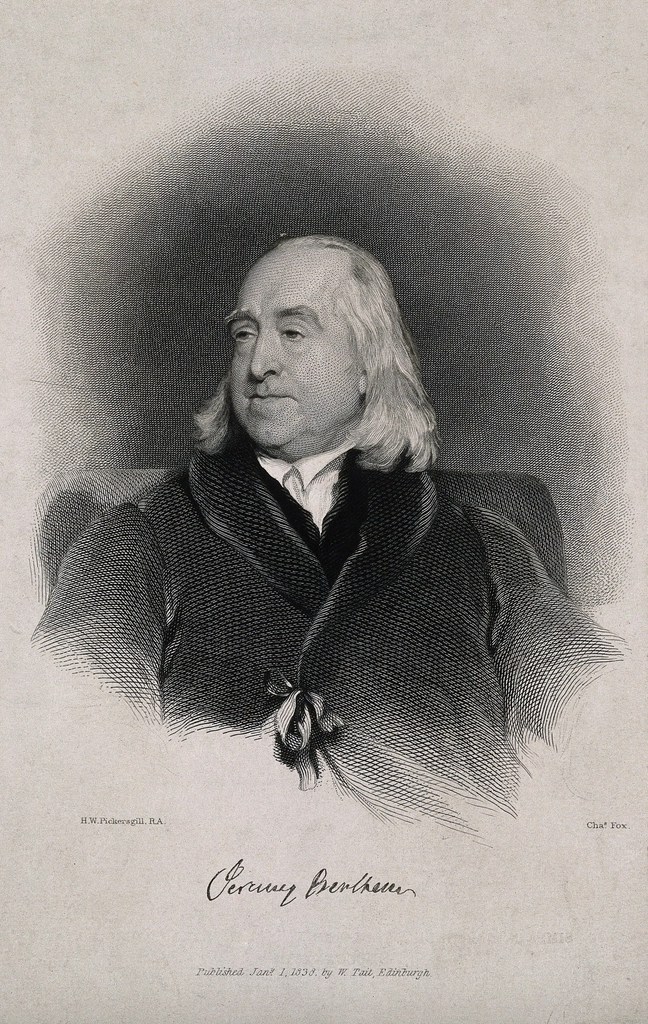
Can law be engineered like a machine – precise, predictable, and built for public good? Bentham believed so.
Jeremy Bentham (1748–1832), the English philosopher and jurist, is often described as the “father of modern jurisprudence” and the principal founder of the utilitarian school of thought. Bentham’s jurisprudence revolves around one fundamental idea: law must serve human happiness. This marked a radical departure from traditional views that treated law as a reflection of divine will or moral absolutes. According to him, the main purpose of law is not merely to maintain order or uphold traditions, but to promote the greatest happiness of the greatest number. This utilitarian principle shaped his theories of codification and legal reform, which continue to influence modern legal systems across the world.
Bentham’s Concept of Law as a Social Instrument
Bentham viewed law as a social instrument designed to regulate human behavior for the benefit of society. Bentham’s metaphor of law as a “tool” emphasized its adaptability—laws could be redesigned, improved, and optimized like any other human invention. He rejected the natural law theory which claimed that law derives from divine or moral sources. Instead, he proposed a positive law approach — meaning that law is what is laid down by the sovereign authority of the state.
For Bentham, the measure of a good law was its utility — whether it increased overall happiness and minimized pain. Therefore, law was not static or sacred but a tool for social engineering. Through rational legislation and reform, society could be shaped toward greater welfare and justice.
He believed that a clear, consistent, and well-structured legal system could eliminate confusion, arbitrariness, and corruption. Hence, codification became a central part of Bentham’s mission to make law accessible and rational. He envisioned a legal system where every rule was traceable to a rational purpose, not buried in precedent or tradition.
Codification: Making Law Clear and Rational
In Bentham’s time, English law was based on common law traditions, heavily dependent on judicial precedents and filled with inconsistencies. He criticized this system for being uncertain, complex, and inaccessible to ordinary people. He described the common law as “dog law” — laws discovered after the offense was committed, like punishing a dog after it had done wrong, instead of teaching it beforehand.
To solve this, Bentham advocated for codification — the systematic and comprehensive written collection of laws into an organized code. Codification, in his view, served several key purposes:
- Clarity: Written codes would eliminate confusion arising from judge-made law.
- Certainty: Citizens would know beforehand what is lawful or unlawful.
- Accessibility: Laws would be understandable to everyone, not just lawyers.
- Accountability: Legislators could be held responsible for the content of laws, unlike unelected judges.
- Utility-based consistency: Laws could be designed and amended systematically according to their social utility.
1. Table: Goals and Benefits of Codification
| Goal of Codification | Bentham’s Rationale |
| Clarity | Eliminate confusion from judge-made law |
| Certainty | Enable citizens to know legal consequences in advance |
| Accessibility | Make law understandable to non-lawyers |
| Accountability | Shift responsibility from unelected judges to elected legislators |
| Utility-based Consistency | Design laws systematically to maximize happiness and minimize harm |
Bentham’s codification was not just administrative—it was philosophical. It aimed to democratize law by making it intelligible and accountable. Bentham’s idea of codification was not merely about writing down laws — it was about restructuring law based on rational and utilitarian principles. He even drafted a model code, called the “Pannomion”, which aimed to cover all areas of law — civil, penal, and constitutional. Though never adopted, the Pannomion remains a landmark in legal theory—a blueprint for comprehensive, utility-driven legislation.
Legal Reform: Dynamic Application of Utility
Bentham’s concept of legal reform went hand in hand with codification. He believed that the law must evolve in response to the changing needs of society. Since the aim of law is the promotion of happiness, any law that causes unnecessary pain or serves outdated interests must be reformed or abolished.
His theory of law as a social instrument demanded that laws be evaluated through the “felicific calculus”, a method he proposed to measure pleasure and pain resulting from any legal rule. This calculus considered factors like intensity, duration, certainty, and extent of pleasure or pain—making moral evaluation a quantifiable exercise. The reformer’s task, according to Bentham, was to assess laws through this utilitarian lens — asking whether they contribute to the welfare of the community.
He advocated reforms in many areas including criminal law, punishment, and legal procedures. For instance:
- Punishments should be proportionate to the offense and aimed at deterrence and reformation, not vengeance.
- Civil laws should protect property, contracts, and expectations to encourage economic growth and social stability.
- Administrative and constitutional laws should ensure transparency and accountability in governance.
2. Table: Bentham’s Legal Reform Principles
| Legal Area | Bentham’s Reform Principle |
| Criminal Law | Punishment should be proportionate and aimed at deterrence, not vengeance |
| Civil Law | Protect property, contracts, and expectations to support economic and social stability |
| Constitutional Law | Promote transparency and accountability in governance |
| Legal Procedures | Simplify and rationalize processes to reduce delay and confusion |
In this sense, Bentham’s utilitarianism gave birth to the modern idea of law as a means of social reform, a notion later expanded by thinkers like Roscoe Pound and modern welfare jurists. Pound’s sociological jurisprudence echoed Bentham’s insight: law must evolve with society and serve its changing needs.
Influence of Bentham’s Codification Theory
Although Bentham’s proposals were too radical for his own time, his influence spread worldwide. His ideas inspired the codification movements in several countries:
- The Indian Penal Code (1860), drafted by Lord Macaulay, reflects Bentham’s utilitarian spirit of clarity and social purpose. Macaulay’s drafting committee drew heavily on Bentham’s principles—clarity, deterrence, and proportionality were central to the IPC’s design.
- The French Civil Code (Napoleonic Code) also embodies the systematic approach Bentham admired.
- In the 19th and 20th centuries, legal codification became a hallmark of modern legal systems globally, from Europe to Asia.
Table: Global Influence of Bentham’s Codification Ideas
| Country/Code | Benthamite Influence |
| India (IPC, 1860) | Clarity, deterrence, and proportionality in criminal law |
| France (Napoleonic Code) | Systematic structure and accessibility |
| UK (Law Commission) | Ongoing codification and simplification efforts |
| Global (Welfare States) | Utility-based legislative reforms in health, education, and criminal justice |
Bentham’s belief that law should be made for the people and by reason shaped democratic and transparent lawmaking processes. His emphasis on reform still guides modern legislative bodies that seek to update outdated laws to meet present realities. Bentham’s reforms were not just legal—they were ethical. His utilitarianism provided a moral compass for lawmakers, distinct from religious or natural law traditions.
Law, Morality, and Utility
Bentham’s separation of law and morality does not mean he was indifferent to ethics. Rather, he replaced moral intuition with rational moral calculation — the principle of utility. He maintained that moral and legal rules should both aim at maximizing happiness, but only legislators, not judges or priests, should decide how that is achieved in law.
Thus, for Bentham, utility became the bridge between law and morality — a scientific way of aligning legislation with human welfare. This bridge allowed law to remain secular and scientific, while still being guided by human values—chiefly, the pursuit of happiness.
Can modern legal systems retain Bentham’s clarity and purpose in an age of complexity and pluralism? His legacy challenges us to try.
Conclusion
Jeremy Bentham’s philosophy of codification and legal reform revolutionized the understanding of law as an active, rational, and socially useful instrument. His utilitarian framework transformed law from a mere set of traditional commands into a scientific tool for public good.
Codification made the law clear and predictable, while reform ensured it remained relevant and humane. Bentham’s approach continues to guide lawmakers worldwide — reminding us that the ultimate purpose of every legal system should be to promote the greatest happiness of the greatest number.
References:
- Jeremy Bentham, An Introduction to the Principles of Morals and Legislation (1789).
- H.L.A. Hart, Essays on Bentham: Jurisprudence and Political Theory (Oxford University Press, 1982).
- Roscoe Pound, Jurisprudence (1959).
- R.W.M. Dias, Jurisprudence (5th ed., 1985).
- Lloyd, Introduction to Jurisprudence (8th ed., 2008).
#JeremyBentham #Codification #LegalReform #Utilitarianism #LawAsSocialInstrument #LegalPhilosophy #BenthamJurisprudence #LawAndMorality #LegalTheory #JurisprudenceBlog #LawReform #BenthamUtility #LegalPositivismExplained #FelicificCalculus
🎧 Listen on Spotify: Codification & Legal Reform
Discover more from Dr. Ganesh Visavale
Subscribe to get the latest posts sent to your email.
 Dr. Ganesh Visavale