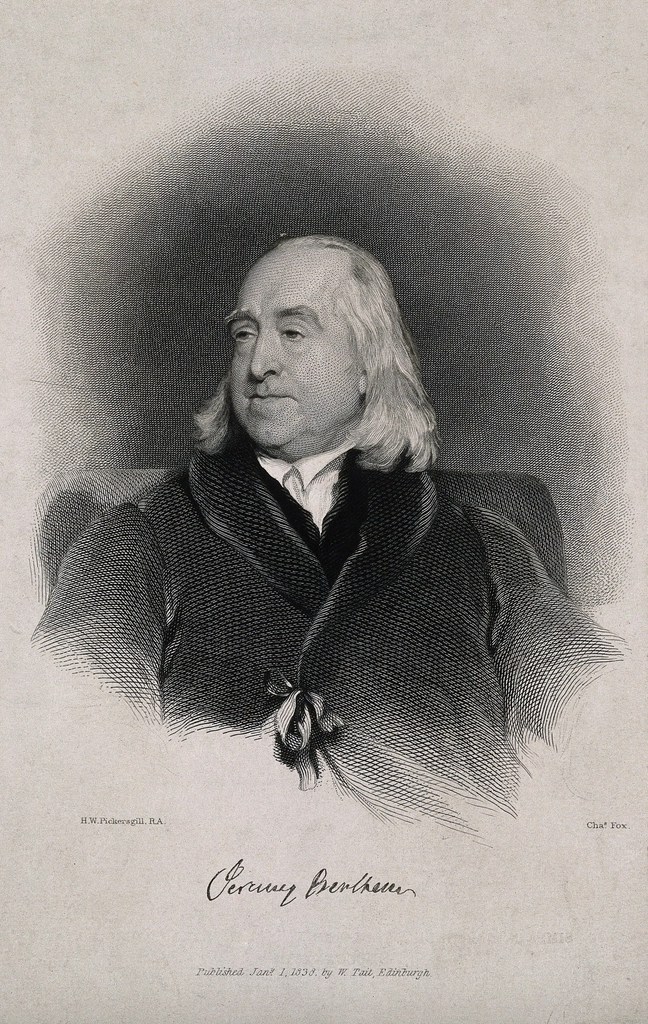
📖 In our previous blog Jeremy Bentham: The Architect of Utilitarian Jurisprudence, we explored Jeremy Bentham’s life and the intellectual climate that shaped his philosophy. Building on that foundation, this article explains his most famous idea – the Principle of Utility.
When we study legal philosophy, one question always stands out: What is the purpose of law? For centuries, answers varied – some believed law reflected the will of God, others said it was the wisdom of ancestors, and still others treated it as the command of kings.
Jeremy Bentham (1748–1832) gave a radically different answer. He declared that law exists for one reason only: to maximize happiness and minimize suffering. This, he called, the Principle of Utility.
Bentham’s Radical Idea
Bentham’s philosophy began with a simple observation: human beings are governed by two sovereign masters – pleasure and pain. Every choice we make, every action we take, is driven by the pursuit of pleasure or the avoidance of pain.
Why should law be any different? If laws cause more suffering than happiness, they fail their true purpose. If they bring more happiness than pain, they succeed.
Thus, Bentham offered a new moral test:
- ✅ A law is good if it increases overall happiness.
- ❌ A law is bad if it increases overall suffering.
This sounds straightforward today, but in Bentham’s time it was revolutionary. Law was no longer to be respected simply because it was old, sacred, or backed by authority. Its worth depended on its usefulness to society.
The Greatest Happiness of the Greatest Number
Bentham famously summed up his principle as the “greatest happiness of the greatest number.”
Here, happiness did not mean fleeting pleasure but the overall well-being of individuals in society. Bentham did not argue for the happiness of the elite few or the preservation of traditions that benefitted the powerful. Instead, he demanded that lawmakers consider the collective welfare of the majority.
This democratic spirit made his philosophy both radical and practical. Law was for people – and it must work for their good.
The Hedonic Calculus: Can Happiness Be Measured?
One of Bentham’s boldest ideas was that happiness and suffering could be measured. To achieve this, he proposed the hedonic calculus, a framework for evaluating the consequences of actions and laws.
He suggested weighing pleasure and pain by:
- Intensity – How strong is the feeling?
- Duration – How long will it last?
- Certainty – How likely is it to happen?
- Proximity – How soon will it happen?
- Fecundity – Will it lead to more pleasures?
- Purity – Will it be free from resulting pains?
- Extent – How many people will be affected?
For example, imagine a new law providing free vaccinations. It may cause short-term pain (the needle prick) but leads to lasting benefits (disease prevention), certainty (scientific proof of effectiveness), purity (more health, less suffering), and wide extent (millions benefit). By Bentham’s calculus, such a law is justified.
While critics accused Bentham of treating happiness like mathematics, his goal was clear: to make law rational, predictable, and accountable.
Why the Principle of Utility Mattered
Before Bentham, law was often treated as mysterious, unquestionable, and controlled by those in power. His principle changed this in three ways:
- Law as a Social Tool – Laws were no longer sacred traditions but instruments for creating well-being.
- Justice with Purpose – Justice was defined not by abstract ideals but by its effect on people’s lives.
- Democratization of Law – Ordinary people, not just rulers or judges, became the focus of law.
Bentham’s idea also challenged the common law system of England, which relied heavily on precedents. He criticized it as “dog law” – unpredictable, confusing, and unfair to the common man. Instead, he called for codified laws written clearly for everyone to understand.
Relevance in Today’s World
Bentham’s principle continues to shape modern debates:
- Public Policy – Governments often weigh costs and benefits of laws, from healthcare funding to environmental regulation, in utilitarian terms.
- Criminal Justice – Punishment is justified today not by revenge but by deterrence, reform, and protection — very much in line with Bentham’s thinking.
- Ethics of Technology – From AI surveillance to data privacy, the question remains: does it maximize overall welfare, or cause more harm than good?
Even if we don’t always use Bentham’s terminology, his influence is clear. Policymaking is still about balancing benefits against harms – about measuring happiness and suffering.
Criticism and Legacy
Of course, Bentham’s principle was not without criticism. Can happiness really be measured with numbers? Should the majority’s happiness always outweigh the rights of the minority? These questions later led thinkers like John Stuart Mill to refine utilitarianism.
Yet, despite its limitations, Bentham’s principle gave the world a powerful new way to evaluate laws. It remains one of the most influential ideas in both jurisprudence and moral philosophy.
Conclusion
Bentham’s Principle of Utility was more than a theory – it was a call to reform. He asked lawmakers to stop hiding behind tradition and authority and to start asking a simple question: Does this law make life better for people?
That question is as relevant today as it was in the 18th century. In every debate about law, justice, or policy, Bentham’s voice still echoes: the true purpose of law is the happiness of the people.
📚 References
- Jeremy Bentham, An Introduction to the Principles of Morals and Legislation (1789).
- John Stuart Mill, Utilitarianism (1863).
- H.L.A. Hart, Essays on Bentham (1982).
- Gerald J. Postema, Bentham and the Common Law Tradition (1986).
💡 This is Part II of Legal Remedy’s series on Jeremy Bentham’s Jurisprudence.
#JeremyBentham #PrincipleOfUtility #Utilitarianism #LegalPhilosophy #Jurisprudence #LawAndSociety #LegalRemedy
Discover more from Dr. Ganesh Visavale
Subscribe to get the latest posts sent to your email.
 Dr. Ganesh Visavale
3 Comments