Introduction
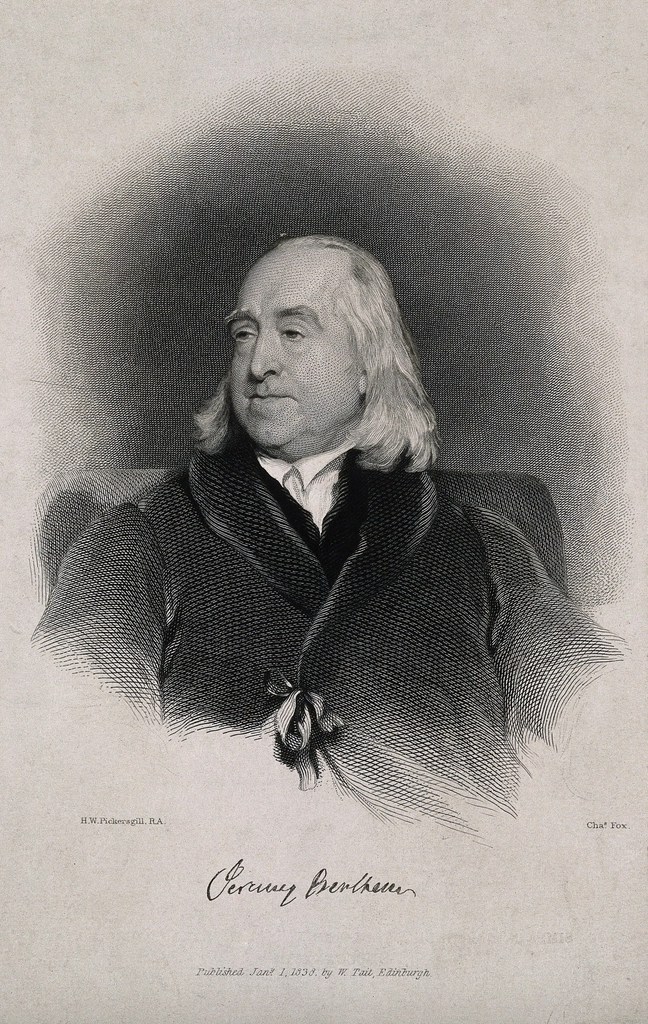
In the landscape of legal philosophy, Jeremy Bentham (1748–1832) occupies a central place as the founder of modern utilitarianism. At a time when English law was an untidy patchwork of precedents, customs, and judicial discretion, Bentham advocated for a rational, codified, and systematic body of laws based on one guiding principle – utility.
Bentham was not content with abstract theorizing. He aspired to create a science of legislation, where laws could be judged and reformed according to their capacity to promote human happiness. His legacy continues to echo in debates about law, rights, punishment, and codification – not only in Europe but also in colonial and post-colonial contexts like India.
This first blog in our Bentham Series introduces Bentham’s life, his philosophy of utility, and his enduring contributions to jurisprudence.
Early Life and Education
Born in London in 1748 to a family of lawyers, Bentham was a prodigy. By the age of three he was studying Latin, and at just twelve he entered Queen’s College, Oxford. He was later admitted to Lincoln’s Inn to pursue legal training.
However, Bentham grew deeply disillusioned with the legal system. His turning point came when he read Blackstone’s Commentaries on the Laws of England. While Blackstone praised the common law as a rational system, Bentham condemned it as archaic, uncertain, and inaccessible – famously describing natural rights as “nonsense upon stilts” and common law as “dog law” (Bentham, Anarchical Fallacies).
The Principle of Utility
At the heart of Bentham’s philosophy is the Principle of Utility, first articulated in An Introduction to the Principles of Morals and Legislation (1789). Bentham declared:
“Nature has placed mankind under the governance of two sovereign masters, pain and pleasure. It is for them alone to point out what we ought to do …” (Bentham, 1789, Ch. I, para. I).
From this he derived the utilitarian test: laws and actions are justified if they tend to maximize happiness and minimize suffering for the majority. This principle turned morality and legislation into matters of calculation – what Bentham called the Hedonic Calculus.
Bentham’s Critique of Common Law
Bentham’s disapproval of English common law was radical. He criticized it for being:
- Uncodified → scattered across precedents and customs.
- Uncertain → judges often shaped law retroactively.
- Archaic → rooted in feudal traditions rather than reason.
He likened it to “dog law,” where punishment comes after the act, much like scolding a dog after it has misbehaved. His solution was codification – clear, written laws accessible to the common people.
Major Contributions to Jurisprudence
- Legal Positivism
Bentham separated what the law is from what the law ought to be. Law was, in his view, the command of a sovereign backed by sanctions, distinct from morality. This formed the basis for John Austin’s later theory of legal positivism. - Utilitarian Ethics in Law
For Bentham, the measure of justice was not tradition or divine authority, but utility. Laws must serve the collective good. - Theory of Punishment
Punishment was inherently an evil (because it inflicts pain), but could be justified if it prevented greater harm. This made him a strong critic of excessive and disproportionate penalties. - Penal Reform and the Panopticon
Bentham famously designed the Panopticon, a circular prison that allowed constant observation of inmates with minimal supervision. Though controversial, it revealed his concern with efficiency, deterrence, and rehabilitation. - Codification of Law
Bentham proposed comprehensive legal codes that were precise, rational, and transparent. His codification ideas influenced later movements in France, Germany, and British India.
Bentham and India
Though Bentham never visited India, his influence reached through British colonial administrators. Thomas Babington Macaulay, who drafted the Indian Penal Code (IPC) of 1860, was guided by utilitarian principles – clarity, simplicity, and accessibility. The IPC remains one of the clearest examples of Benthamite codification in practice, shaping Indian criminal law for more than 160 years.
Criticisms of Bentham
While Bentham was pioneering, his ideas were not without flaws.
- His utilitarianism was accused of being too mechanical, ignoring justice and individual rights.
- His rejection of natural rights as “nonsense” alienated later liberal thinkers.
- The Panopticon was criticized as authoritarian and inhumane.
- Later philosophers like John Stuart Mill refined utilitarianism to account for higher pleasures, while modern jurists like Dworkin emphasized rights as trumps over utility.
Relevance Today
Bentham’s principles continue to resonate:
- Public policy still relies on utilitarian reasoning – weighing benefits against costs.
- Law reforms in India (e.g., replacement of IPC by the Bharatiya Nyaya Sanhita, 2023) reflect the ongoing Benthamite concern with codification and clarity.
- Human rights vs. security, environment vs. development, and AI regulation remain utilitarian balancing acts.
Conclusion
Jeremy Bentham’s legacy lies in his bold attempt to make law rational, scientific, and centered on human welfare. His principle of utility, his critiques of common law, and his push for codification remain cornerstones of modern jurisprudence.
In the next part of this series, we will turn to Bentham’s theory of punishment – examining when, and why, the deliberate infliction of pain by the state can be morally and legally justified.
In the next part of this series, we’ll dive into Bentham’s core idea – The Principle of Utility, also known as the ‘greatest happiness formula.’ Stay tuned.”
📚 References
- Bentham, Jeremy. An Introduction to the Principles of Morals and Legislation. 1789.
- Bentham, Jeremy. A Fragment on Government. 1776.
- Bentham, Jeremy. Anarchical Fallacies. 1796.
- Bentham, Jeremy. The Rationale of Punishment. 1830.
- Hart, H.L.A. Essays on Bentham: Studies in Jurisprudence and Political Theory. Oxford University Press, 1982.
- Postema, Gerald J. Bentham and the Common Law Tradition. Oxford University Press, 1986.
- Dinwiddy, J.R. Bentham: Selected Writings of John Dinwiddy. Routledge, 2004.
- Internet Encyclopedia of Philosophy (IEP), “Jeremy Bentham.” https://iep.utm.edu/jeremy-bentham
#JeremyBentham #Utilitarianism #PhilosophyOfLaw #LegalTheory #Jurisprudence #LawAndMorality #LegalPhilosophy #ReformativeJustice #CodificationOfLaw #GreatestHappinessPrinciple #EthicsAndLaw #LegalHistory #PublicDomainPhilosophy #BenthamSeries #LawStudents #LegalResearch #PhilosophicalJurisprudence #LegalBlog #OpenAccessLaw #LawAndSociety
Discover more from Dr. Ganesh Visavale
Subscribe to get the latest posts sent to your email.
 Dr. Ganesh Visavale
3 Comments