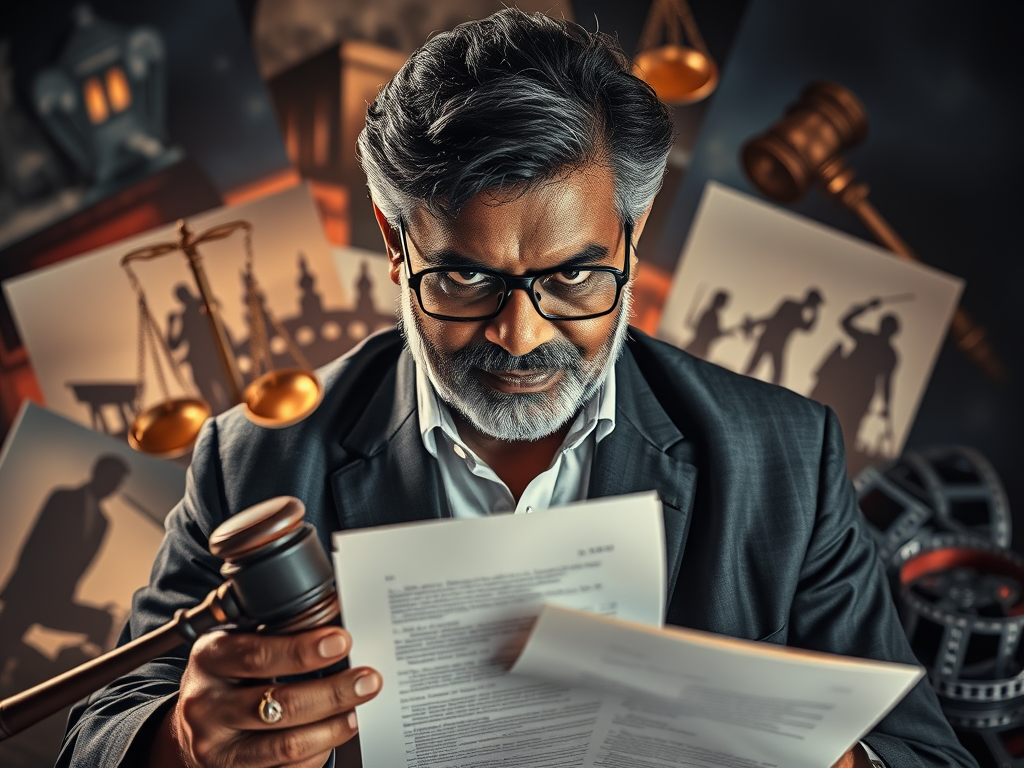
The Enforcement Directorate (ED) recently attached assets worth ₹10.11 crore belonging to renowned filmmaker S. Shankar under the Prevention of Money Laundering Act (PMLA), 2002. The action stems from an intellectual property (IP) dispute, raising critical questions:
✅ Can a civil copyright dispute be treated as a financial crime?
✅ Does this set a precedent for prosecuting creative professionals arbitrarily?
✅ How does this compare to global legal practices?
“Wherever law ends, tyranny begins.” – John Locke
This unprecedented move has sparked widespread debate on the overreach of financial crime agencies into civil disputes, a practice unheard of in jurisdictions like the U.S., U.K., and E.U.. 🚨
📜 Background: Copyright, Civil Disputes & ED’s Overreach
1️⃣ Copyright Disputes Are Traditionally Civil Cases
Globally, copyright infringement cases are handled as civil disputes through courts or arbitration. For instance:
📌 U.S.: Fair Use Doctrine under the Copyright Act, 1976
📌 U.K.: Copyright, Designs & Patents Act, 1988
📌 E.U.: Intellectual Property Rights Enforcement Directive (IPRED)
💡 In none of these jurisdictions do financial enforcement agencies intervene in copyright matters.
2️⃣ ED’s Move: A Legal Overstep?
The ED’s involvement in Shankar’s case blurs the lines between financial fraud and civil disputes. By invoking the PMLA, the agency misconstrues a copyright claim as a money laundering offense, despite no clear proceeds of crime being established.
⚖️ Legal Maxim: Ubi jus, ibi remedium – “Where there is a right, there is a remedy.”
✅ Remedy for copyright infringement lies in civil courts, not in financial crime prosecution.
⚖️ Legal Doctrines & Landmark Case Laws
1️⃣ PMLA’s Overreach: Violating Legal Precedents
📌 Case: Gautam Kundu v. Manoj Kumar (2015) (AIR 2015 SC 3410)
- The Supreme Court ruled that the ED can act only if a scheduled offense under PMLA is proven.
- Copyright infringement is NOT a scheduled offense.
📌 Case: State of Haryana v. Bhajan Lal (1992) (1992 Supp (1) SCC 335)
- The court prohibited misuse of criminal law to settle civil disputes.
📌 Case: Sony Corporation v. Universal Studios (U.S.)
- Hollywood’s “Betamax case” confirmed that copyright disputes should be civil matters.
🚨 If the ED’s actions are upheld, this could lead to arbitrary financial investigations against any artist, writer, or musician.
🌍 A Global Perspective: India vs. The World
| Country | Legal Approach to Copyright Disputes | Notable Case |
|---|---|---|
| 🇺🇸 U.S. | Civil litigation, Fair Use doctrine | Avatar vs. Roger Dean’s artwork (Dismissed) |
| 🇬🇧 U.K. | Copyright cases handled under civil law | The Da Vinci Code lawsuit (No financial crime charges) |
| 🇪🇺 E.U. | Intellectual property laws, no financial crime charges | The Lion King vs. Kimba the White Lion (Handled as a civil case) |
💡 Why is India treating a copyright dispute as a financial crime when no other major jurisdiction does?
🚨 The Chilling Effect on India’s Film Industry
📌 If the ED’s actions stand, the consequences could be severe:
❌ Filmmakers, musicians, and authors may self-censor to avoid legal harassment.
❌ Investors may hesitate to fund creative projects due to legal uncertainties.
❌ India may lose creative talent to countries with stronger legal protections.
⚖️ Legal Maxim: Lex prospicit, non respicit – “The law looks forward, not backward.”
✅ India must strengthen copyright enforcement through civil mechanisms, not criminal prosecution.
📝 Policy Recommendations: Fixing the Legal Loophole
To prevent future misuse of financial laws against creative professionals, India must:
✔ Clarify that copyright disputes remain civil matters.
✔ Restrict ED’s powers under PMLA to genuine financial crimes.
✔ Introduce fast-track copyright tribunals for efficient resolution.
⚠ If left unchecked, this legal overreach could permanently damage India’s creative economy.
🤔 Final Thoughts: What’s at Stake?
The ED’s actions against S. Shankar may appear isolated, but they set a precedent that could affect every creative professional in India.
💭 Should copyright disputes lead to financial crime investigations?
💭 If this precedent stands, will filmmakers be forced into self-censorship?
💭 How will foreign investors react if India criminalizes artistic expression through financial enforcement?
🚨 If we don’t challenge this legal overreach now, will it soon be too late to reverse?
🔖 Share Your Thoughts!
💬 What do you think about ED’s involvement in copyright cases?
📢 Use #CopyrightLaw #PMLA #CreativeFreedom to join the discussion!
Would you like additional case laws or an even deeper policy analysis before publishing? 🚀
#CopyrightLaw #IntellectualProperty #PMLA #CreativeFreedom #FilmmakersRights #ArtisticExpression #LegalPrecedent #JudicialOverreach #PolicyMatters #IndianJudiciary #KnowYourRights #EDvsCreativity #LegalDebate #FilmIndustry #FreeSpeechMatters
Discover more from Dr. Ganesh Visavale
Subscribe to get the latest posts sent to your email.
 Dr. Ganesh Visavale