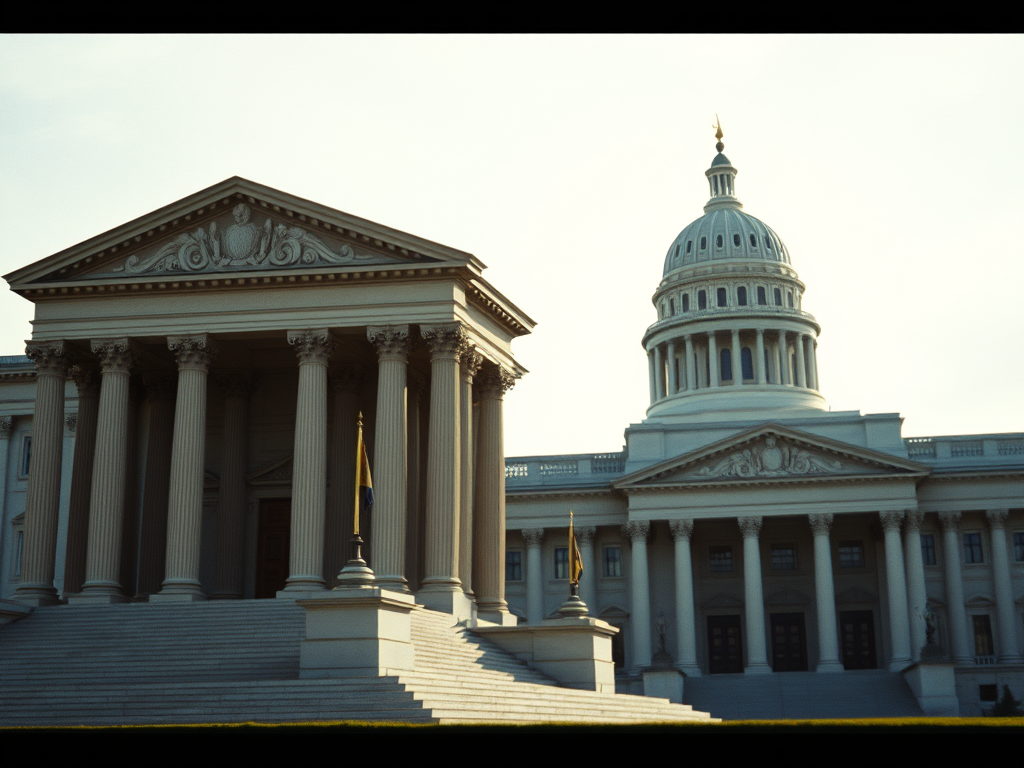
The doctrine of separation of powers (Latin: Trias Politica) is a foundational principle ensuring checks and balances within a democracy. Rooted in Montesquieu’s The Spirit of the Laws (1748), this doctrine divides government power among three branches – Legislature 🏛️, Executive 🏢, and Judiciary ⚖️ – each with distinct responsibilities to prevent authoritarian rule (Potestas potestate coercenda est – Power must be checked by power).
📜 Historical Background
The concept dates back to ancient Greece and Rome, but it was Montesquieu who famously articulated that liberty thrives when powers are separated (Ubi jus ibi remedium – Where there is a right, there is a remedy).
📖 Meaning and Concept
The doctrine ensures that:
- 🏛️ Legislature (Legislatio) makes laws.
- 🏢 Executive (Executio) implements laws.
- ⚖️ Judiciary (Judicium) interprets laws. This division safeguards rights and prevents the abuse of power (Fiat justitia ruat caelum – Let justice be done though the heavens fall).
🌍 Application in Different Countries
- 🇺🇸 United States: A robust system of checks and balances with judicial review (Marbury v. Madison, 1803).
- 🇬🇧 United Kingdom: A parliamentary system with a fusion of powers.
- 🇮🇳 India: A flexible separation of powers, outlined implicitly through constitutional provisions and judicial interpretations.
⚖️ Doctrine of Separation of Powers in India
India follows a functional separation model, where checks and balances are essential. Important articles and cases include:
- 📜 Article 50: Separation of judiciary from the executive.
- 📜 Articles 121, 122, 211: Protect judicial independence from legislative interference.
- 🏛️ Kesavananda Bharati Case (1973): Established the basic structure doctrine, including separation of powers.
- ⚖️ Indira Gandhi v. Raj Narain (1975): Reaffirmed judicial independence.
- 📚 Minerva Mills Case (1980): Maintained the balance of powers as part of the Constitution’s basic structure.
💡 Significance and Relevance in Today’s Society
🛡️ Prevents Tyranny: No single branch can dominate (Nullum crimen sine lege – No crime without law).
⚙️ Promotes Efficiency: Clear division of responsibilities.
✅ Ensures Accountability: Each branch checks the other (Quis custodiet ipsos custodes? – Who will guard the guards themselves?).
🗳️ Strengthens Democracy: Upholds rule of law and protects human rights.
🚧 Challenges to the Doctrine
⚖️ Judicial Overreach: Courts legislating from the bench (Fiat justitia – Let justice be done).
🏛️ Legislative Encroachment: Attempts to influence judicial appointments (Res judicata – A matter already judged).
🏢 Executive Dominance: Bypassing legislature through ordinances (Salus populi suprema lex esto – The welfare of the people is the supreme law).
🏁 Conclusion
️The doctrine of separation of powers, enriched by landmark case laws and legal principles, remains vital for democratic governance.
In India, the functional separation guided by judicial precedents ensures that power is wielded fairly (Audi alteram partem – Let the other side be heard).
Upholding this doctrine is imperative for a just, accountable, and vibrant democracy. ⚖️📜🗳
#SeparationOfPowers #ConstitutionalLaw #LegalResearch #Democracy #Judiciary #Legislature #Executive #LawStudents #CaseLaws #RuleOfLaw #UPSC #JudiciaryExams
Discover more from Dr. Ganesh Visavale
Subscribe to get the latest posts sent to your email.
 Dr. Ganesh Visavale